 4.8 on G2 Trusted by 3k+ teams worldwide

Only 35% of UK employers say they're confident their benefits package, pension included, is actually good, according to CIPD's Reward Survey in February 2026.
On the employee side, only 52% feel they're paid fairly for what they do, per CIPD's Good Work Index. This leaves a gap between what employers and their staff think is fair pay, and what is actually fair by market rates. And it’s why employees leave when they believe their salary is no longer competitive for their experience and skills, especially when compared with what's on offer elsewhere.
A good total reward strategy is how you nip scenarios like these in the bud. It shows employees what they're actually worth to you: pay, benefits, and recognition, weighed and communicated clearly.
Here's the five-step process for building one, so you can hang on to good people and cut turnover.
TL;DR: How to build a total reward strategy
- Only 35% of UK employers are confident their benefits package, pension included, is actually good, and just 52% of employees feel they're paid fairly.
- Divide a supervisor's base pay by the lower grade's. A result below 1.10 means less than a 10% gap, and that's when a promotion stops feeling worth it.
- Total reward value is the sum of base pay, employee benefits, and bonuses. That's the figure worth putting in front of employees.
- Reallocating an unused benefit into the most compressed pay grade often beats spreading a small pay rise across the whole team.
- Employee recognition is immediate and personal in a way an annual pay review can't be. That’s why it earns a real, budgeted place in a total reward strategy.
What you need before you start
People use “total reward” and “strategic reward” like they're the same thing, but they're not. Total reward is everything employees value about work right now: pay, perks, all of it. Strategic reward is making sure that stuff still makes sense for where the business and the workforce are heading.
Before you start building a total reward strategy, you need:
- Your current pay data by role and grade
- A rough total spend on benefits and perks
- Turnover and recruitment difficulty by role
- Exit or survey feedback
Make sure that data's current, too. Last year's pay data is most likely already stale, and you won't be able to diagnose pay compression accurately if the numbers underneath it are out of date.
How to build a total reward strategy in five steps
1. Audit everything you currently pay
This stage shows you where your reward budget's actually going, and what it's actually buying you. Pull together everything you're already funding, however small the direct cost:
- Base pay, shift premiums, and overtime
- Bonuses and commission
- Pensions and insurance
- Employee discounts and wellbeing support
- Training and flexible working
- Any employee recognition program
Most HR teams underestimate what they're already spending on total reward, because it's scattered across separate budgets. List everything, including things you assume nobody notices, like a wellbeing subscription nobody's touched in six months.
The output of this stage is a cost inventory showing what you offer, who receives it, what employees actually use, and where money could be released.
2. Diagnose where pay is compressing or falling behind
Some of your pay structures are probably already causing a retention or progression problem. Check external market rates against your own pay gaps, and start with roles showing:
- High turnover
- Repeated vacancies
- Declining offer acceptance
- Growing reliance on overtime and agency staff
Then look at the pay gaps between entry-level employees, experienced employees, and first-line managers. The National Living Wage rose 4.1% to £12.71 an hour from April 2026, and each rise compresses the gap between an entry-level role and the supervisor roles above it.
Pay compression ratio: Higher grade's base pay divided by lower grade's base pay. A ratio below 1.10 means less than a 10% gap between the two grades.
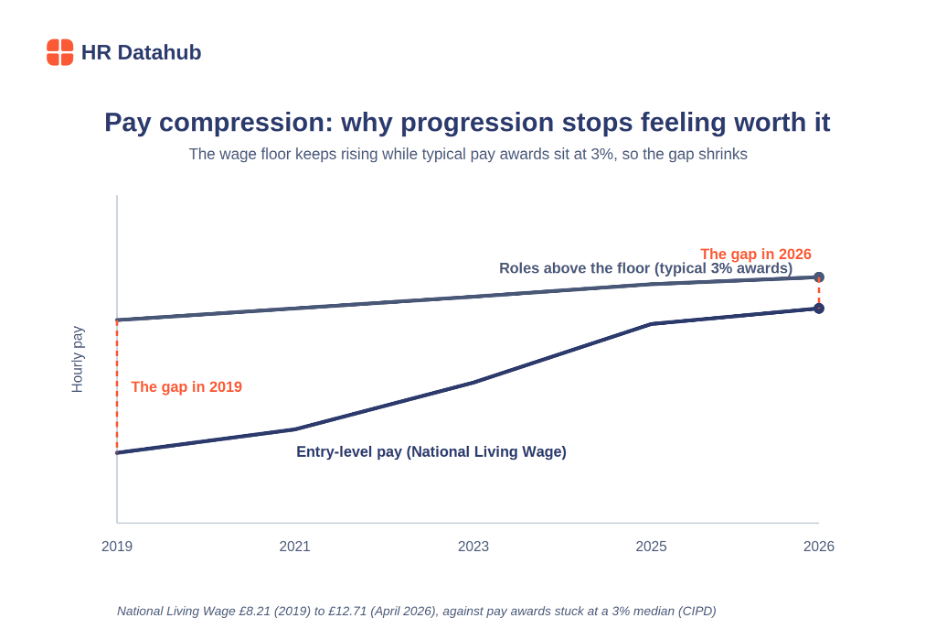
Where competitors offer similar work, people move for a few pence more because it's effectively the same job. Pay compression is a close cousin of wage drift, where pay quietly moves away from market rate without anyone deciding it should.
But not every below-market role needs fixing right away. Some roles are easy to fill and keep despite modest pay; others can grind an entire operation to a halt when a single vacancy sits open.
The output here is a risk map showing which roles need immediate action, which need monitoring, and which remain appropriately positioned.
3. Decide your reward mix and what you can afford
Base pay is the lever people notice first, but it's not the only one you have. CIPD's guidance on strategic and total reward frames this as a deliberate choice across pay, benefits, and non-financial reward.
But that doesn't mean every role gets the same percentage increase.
A flat award can preserve existing problems or make compression worse; a targeted increase usually offers more retention value, provided you can explain the rationale and it holds up under a fairness check. Getting that rationale right is its own skill, and a proper salary adjustment framework covers exactly this kind of case-by-case reasoning.
Where the budget is fixed, reallocate budget from underused allowances and low-value benefits into base pay, healthcare or employee discounts. Factor in the recurring employer National Insurance and pension costs for a salary increase before you commit.
HeyTaco's breakdown on the importance of recognition in a total reward package is worth a read if you want to see how that plays out in practice.
4. Build in employee recognition and healthy work culture
Turn employee recognition into a consistent part of how work gets managed, rather than an annual add-on.
According to Resource Guru's State of (Over)working study, 84% of UK desk workers regularly work unpaid overtime. Recognition needs to show up as often as the extra hours do; a genuinely healthy culture tackles the overtime itself alongside recognizing the people absorbing it.
It can't repair low pay, but it strengthens the offer once the basic reward package is credible. People want to be appreciated for doing good work, especially when it's visible to colleagues but easy for senior leaders to miss.
Keep it timely, specific, and build it into how people actually work day to day. A note explaining how someone helped a customer, supported a colleague, or caught a problem before it became one carries more weight than a generic monthly award.
And if you're adding wellness alongside recognition, this guide to burnout-proofing a workplace is a useful next step.

5. Communicate the full value of the reward package to employees
Employers spend real money on pensions, paid leave, development, wellbeing, and insurance. They go way beyond the salary line employees can already see, and then never explain what any of it's actually worth.
Total reward value: Base pay + pension + annual benefits value + average bonus or variable pay + employee recognition, career development, and other additional perks. That combined number, not base salary alone, is what's worth putting in front of people weighing up an offer elsewhere.
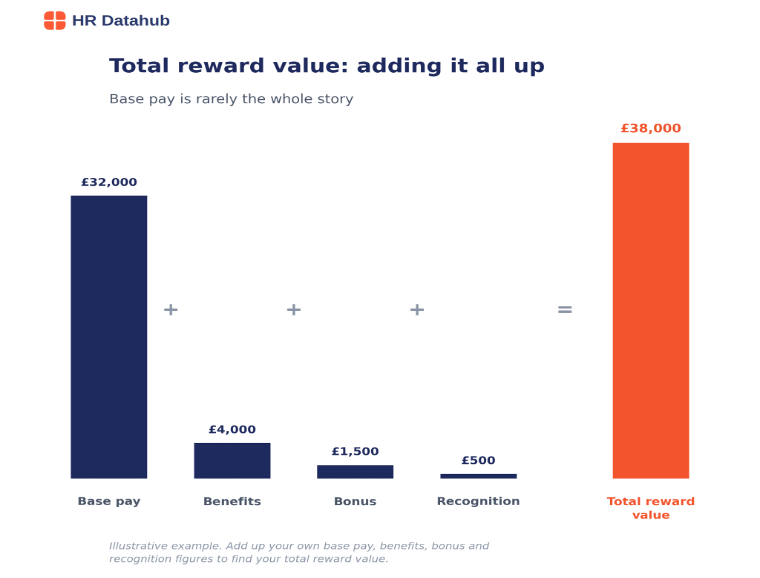
Be upfront about how employees access each part and who to ask if they've got questions. Don't inflate the numbers on cultural benefits or recognition; people see through an exaggerated calculation fast.
Time communication around moments that matter, like during pay reviews, promotions, or work anniversaries. This breakdown of turnover prevention tactics is a solid companion piece for other non-pay levers you can implement.
A worked example: Reallocating a stretched budget
Say a retail employer has a flat pay budget for 2026 and a compression problem between shift supervisors and the team they manage, a gap of roughly £400 a year.
The audit shows £15,000 a year going toward an unused gym membership perk, taken up by fewer than a tenth of staff. The diagnosis confirms the supervisor gap is the single biggest retention risk in the business, worse than anywhere else in the structure.
The decision: Redirect that £15,000 into a targeted pay uplift for the supervisor grade. Across 30 supervisors, that's £15,000 ÷ 30 = £500 extra each. Add that to the existing £400 gap, and the new gap closes to a meaningful £900 a year.
The communication: A short note to affected staff explaining the change, plus a total reward summary showing the new package's full value.
None of this needs new money. It needed the existing spend redirected to the actual problem.
Common pitfalls when building a total reward strategy
A few mistakes come up again and again when I look at reward strategies that haven't worked:
- Adding without auditing: Bolting on a visible new benefit before correcting a serious pay gap usually adds cost without touching the real retention risk.
- Treating recognition as the whole answer: It's a genuine lever, but it works best alongside a real fix for the pay gaps beneath it.
- Spreading the budget too thin: A very small amount for everyone can leave the highest-risk roles unchanged; concentrated action usually does more.
- Ignoring the evidence you already have: If several employees cite the same reason for resigning, or you have benefits people barely touch, do not ignore it.
- Copying a competitor's package wholesale: What retains people at a 2,000-person business rarely translates directly to a 200-person one.
Start with the stage that hurts most
You don't need to fix all five stages of your total reward strategy in one quarter. Pick whichever one is causing the most damage right now, usually the diagnosis, and start there.
If you take one thing from this: pounds matter more than percentages when you're diagnosing where reward is failing. A 3% uplift sounds meaningful in a pay review meeting and can still leave two grades sitting within a few hundred pounds of each other.
Revisit your reward strategy every time your pay data, your headcount, or your budget changes, because all three will.
Author Bio

David Whitfield is the CEO and co-founder of HR DataHub, a salary benchmarking platform that draws data from over 40 million live job postings to help HR teams make confident, data-driven pay decisions they can stand behind. With more than 20 years of experience in HR and Reward, he is passionate about empowering organizations to make smart, defensible decisions more quickly and easily than ever before.
Frequently asked questions
What are total rewards strategies?
A total rewards strategy is a deliberate plan that weighs pay, benefits, wellbeing, recognition, and career development together as one budget, used to attract and retain employees. In practice, that means treating a pay rise, a wellness perk, and a recognition scheme as competing options from the same pot of money. Each is judged against the same fairness test, instead of approving each request in isolation as it comes up.
What are the 5 pillars of total rewards?
Total rewards pillars are usually grouped into five areas: compensation (base and variable pay), benefits, wellbeing, recognition, and career development. Each pillar can hold several reward schemes for employees, and the five work as a set. A strong salary rarely offsets a workplace where growth stalls and contribution goes unnoticed. Grouping them this way is what stops HR teams from over-investing in one pillar, usually pay, while the other four quietly go unfunded.
What is the total reward approach?
The total reward approach treats everything an employee values about working for an organization, pay, benefits and non-financial provisions alike, as one connected package. That includes flexible working, development, and recognition alongside pay and benefits. In practice, it means a retention problem gets solved with whichever lever actually fixes it. Sometimes pay, sometimes something else entirely, based on what the evidence shows.


